0
Shares
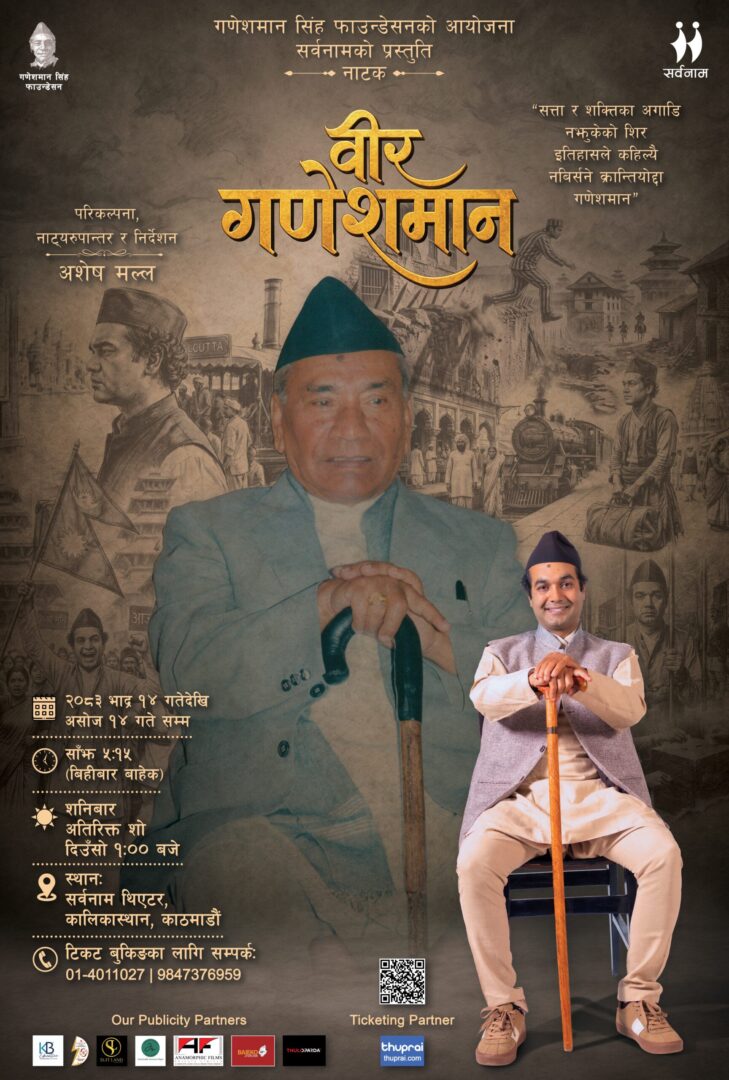



KATHMANDU — The historical play ‘Bir Ganeshman’, based on the life and political struggle of Nepal’s democratic leader Ganeshman Singh, will be staged at Sarwanam Theatre in Kalikasthan, Kathmandu, from Bhadra 14 to Ashoj 14.
Organised by the Ganeshman Foundation and presented by Sarwanam, the play explores Singh’s life, struggle, sacrifice, courage and commitment to democracy. Veteran theatre artist Ashesh Malla has conceived, adapted and directed the production.
According to Malla, ‘Bir Ganeshman’ is not simply a biographical play about a historical figure. It is also a story about integrity, honesty, sacrifice and devotion to the nation.
Malla said the production marks the first time in his nearly five-decade theatre career that he has undertaken such a realistic play. He said the production differs from his usual practice of working extensively with imagery and symbolism.
The play focuses on Singh’s struggle against the autocratic Rana regime, his imprisonment at Bhadra Gol Jail and his dramatic escape by scaling a roughly six-foot-high prison wall.
It also portrays Singh’s determination to continue fighting for democracy despite facing the possibility of a death sentence. His sacrifice, courage and unwavering commitment are presented as central elements of the production.
Another major episode featured in the play is Singh’s decision to reject the post of prime minister after the success of the 1990 People’s Movement.
The production seeks to highlight Singh’s political philosophy of placing the country, people, rights and freedom above personal interests, family, party, political office and power.
Sarwanam, which is presenting the play, is one of Nepal’s long-established theatre groups. Founded in 1981, the organisation has been active for more than four decades in the development, promotion and preservation of Nepali theatre.
Sarwanam also played a role in raising social and political awareness through theatre during the Panchayat era and is credited with institutionalising street theatre in Nepal.
The organisation has built its own theatre through its own labour and resources rather than relying on government or external grants, establishing itself as an example of self-reliance and institutional continuity in Nepali theatre.
Sarwanam has also organised national and international theatre festivals and regularly conducts performances, workshops and theatre training programmes aimed at supporting a new generation of theatre artists.
Through ‘Bir Ganeshman’, Sarwanam says it aims to bring an important chapter of Nepal’s history to younger audiences while renewing attention to the values of country, people, freedom and integrity.