0
Shares



Kathmandu. The 102nd birth anniversary of late Hariprasad Rimal, Nepal Radio’s first singer and a distinguished theatre artist and actor, was marked with a special programme in Kathmandu on Friday.
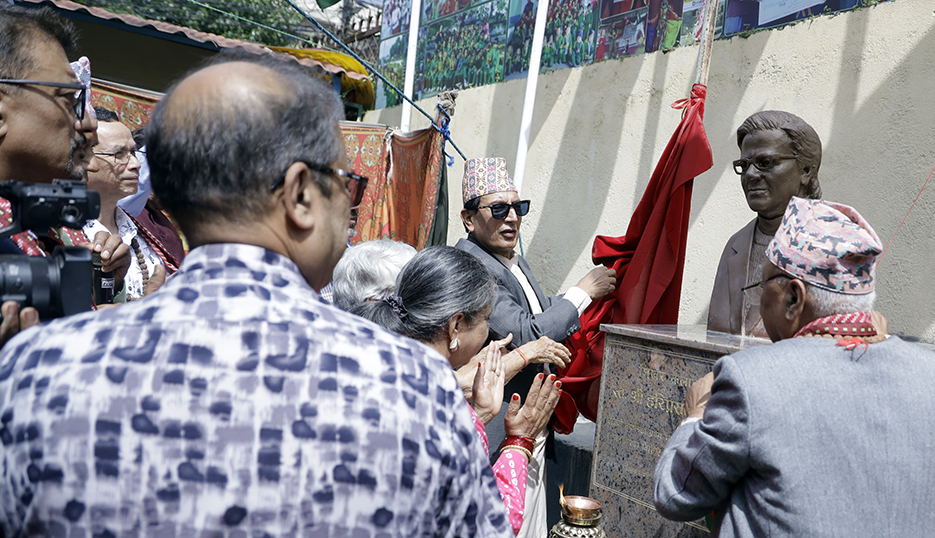
Organised by the Hariprasad Kalyani Rimal Natya Sangeet Pratisthan, the event also featured the unveiling of a bust of Rimal at his residence in Mid-Baneshwor, Kathmandu.
Professor Dr Vasudev Tripathi, chair of the programme and president of the Pratisthan; founding patron Kalyani Rimal; and chief guest Brajesh Khanal, chancellor of the Nepal Academy of Music and Drama, jointly unveiled the bust created by sculptor Lay Prasad Mainali.
The Pratisthan also honoured individuals for their contributions to the fields of art, music and communication. Veteran theatre artist and actor Harihar Sharma received the Hariprasad Kalyani Rimal Natya Sangeet Samman Award, along with a cash prize of Rs 51,001.
Journalist Birendra Jairy was presented with the Hariprasad Kalyani Rimal Natya Sanchar Sewa Samman Award, while singer and musician Sanjay Shrestha received the Hariprasad Kalyani Rimal Natya Sangeet Special Samman Award. Both awards carried a cash prize of Rs 31,001.
The programme also featured performances of songs associated with Rimal. Singer J Papi performed ‘Na Ta Samjhinu Na Ta Birsanu’, Ghanshyam Gautam presented ‘Bina Badal Asina Pardaina’, and Kapil Lohani performed ‘Fagat Ek Najarma’.
Welcoming guests, Pratisthan member secretary and actor Samrat Sapkota said the organisation was working across art, literature and music to preserve Rimal’s legacy. He also announced plans to establish a theatre at Rimal’s residence and a film studio in Namobuddha. Sapkota said the Pratisthan had previously organised theatre festivals and short film competitions and was now preparing to organise a music festival.
Chief guest Brajesh Khanal described the event, held ahead of the Dashain festival, as another major celebration for Nepal’s artistic community. He said earlier generations of music and art carried a strong sense of soul and argued that this quality was gradually being lost amid the desire for quick results. Khanal also expressed interest in having the Nepal Academy of Music and Drama collaborate on the Pratisthan’s planned music festival.
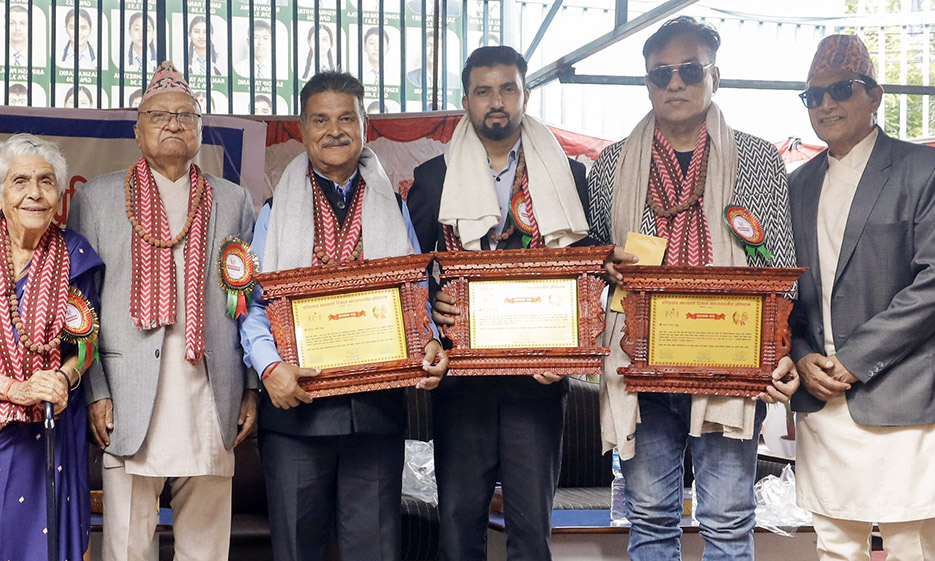
Speaking on behalf of the award recipients, actor Harihar Sharma recalled Rimal’s attention to even the smallest details and his emphasis on natural and simple acting. Sharma said he continues to remember Rimal’s approach when performing.
Programme chair Professor Dr Vasudev Tripathi said the installation of Rimal’s bust had given him the feeling that the veteran artist had returned once again.
Rimal is widely recognised as a pioneering figure in Nepali radio drama. Following the establishment of Radio Nepal, he recorded the song ‘Dil Tukra Bhaera Aankhako Bato Bagechha’, written by Shankar Lamichhane, around 1950/51, becoming the first singer to record a song for Radio Nepal. He also made a significant contribution to the development of radio drama and is remembered as a pioneering figure in the genre.
A distinguished theatre and radio drama director, Rimal was active in theatre, film acting and singing. He was among the early artists of Nepal’s film industry and acted in Aama, the first film shot in Nepal with Nepali artists. He later appeared in films including Manko Bandh and Ke Ghar Ke Dera. He was also involved in film direction.
Over a career spanning nearly seven decades, Rimal made contributions across theatre, radio, music and acting. He is regarded as one of the early-generation artists who helped advance Nepali theatre both artistically and professionally.
Rimal was born on Ashoj 4, 1982 BS, and died on Bhadra 15, 2075 BS.