0
Shares





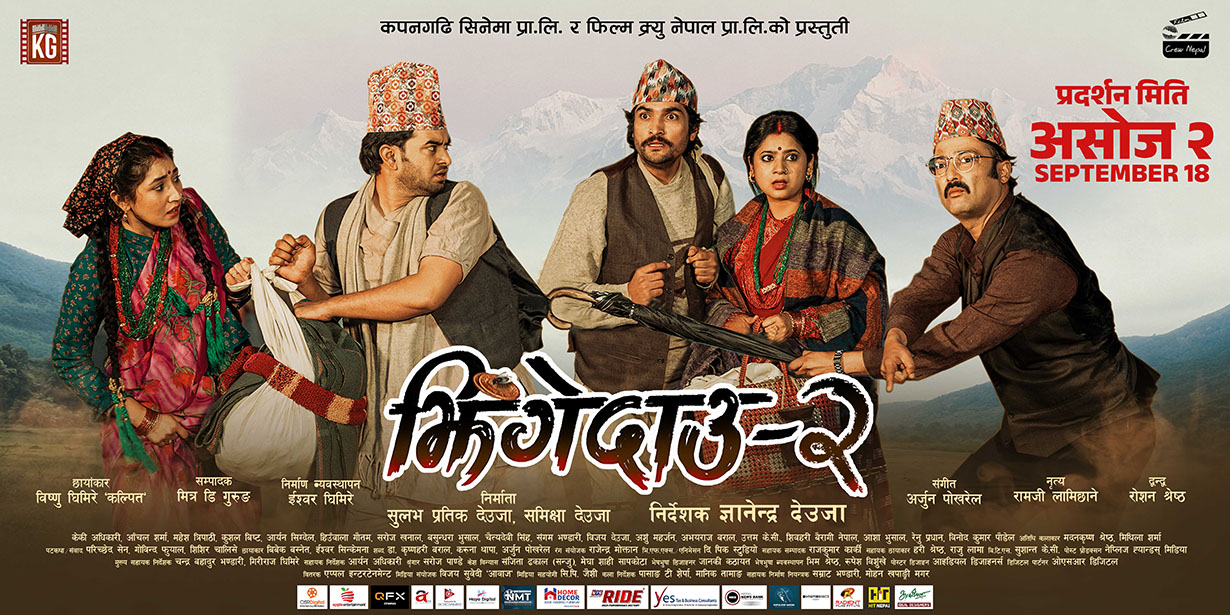
Kedar Ghimire, popularly known as ‘Magne Budho,’ spent his childhood and the years before establishing himself as an artist in poverty and hardship. On Bhadra 6, the film Magne Raja, starring him, will be released. The film presents the story of what happens when a poor man suddenly becomes unimaginably rich—how the psychology of money will lead him into a whirlwind, a storm, or heaven.
Optimistic about the film, what does money mean for Ghimire himself? Mero Picture talked with him about money:
What is money for Ghimire?
“For me, money is like a vehicle. Through it, one can reach a destination. If managed well, it is good, but if not, accidents may happen.”
When there was no money in childhood
Growing up in scarcity, the thought of earning money was planted in Ghimire’s mind since childhood.
He says, “There was no money back then. In the village, we had everything except money.”
Because of money, he missed and lacked many things. The memory of not wearing slippers in childhood still feels fresh to him.
“When there was no money, I didn’t wear slippers. On the slopes, slippers would often tear; even if new ones were bought, they would wear out quickly, so I spent a lot of time barefoot. If we had money, we could have lived in a more comfortable place. Another thing was surviving the whole year with only the school uniform. For Dashain, the new clothes meant only the school uniform. Since studying required wearing it, the compulsory uniform—sky-blue shirt and dark-blue trousers—was the Dashain dress too.”
When he asked for a different design and color of clothing, the reply would be: “Didn’t you just get new clothes? Why another one?” Such questions in poverty were helpless and innocent.
His first job to earn money was carrying sand. He worked during school vacations.
“Maybe around 2046–47 BS, a building related to agriculture was being constructed at Bhatte Danda, Lalitpur. While it was being built, there was a system where carrying one dhwang (about seven pathis) of sand from the river earned four rupees.”
He also remembers carrying foreigners’ bags for money.
Foreigners used to visit his village for development projects. At that time, there was no road facility in the village. To take a vehicle, they had to walk to Chapagaun. Ghimire carried the foreigners’ bags from his village to Chapagaun.
Earning money this way too
In his youth, after a house fire in 2050 BS, Ghimire came to Kathmandu.
At that time, ordinary people could enter Singha Durbar without today’s security checks. Maoist insurgency had not yet started, so movement was unrestricted.
He recalled one incident of earning money by chance:
“I was pushing a bicycle that had all parts except the bell working. A man who had mistakenly brought a window grill upside down asked me to help him carry it from Singha Durbar’s main gate to a welding workshop in Maitighar. I agreed. For that work, I was paid 20 rupees, and for returning the item later, I got another 20. That day I earned 40 rupees.”
Oh! So much money can be earned in a day?
During the struggles in Kathmandu Valley, on the day of Dashain’s Ashtami, he earned more than he had ever imagined. Until then, he never knew that much could be earned in a single day.
“It was Ashtami. I didn’t go home for Dashain. At that time, I sold clothes on the Lagankhel bus park footpath. Dashain is a business season anyway, that year I earned 2,000 rupees in one day. That was the first time I realized it was possible to earn that much in a single day.”
Surprised and delighted with the 2,000, he soothed his regret of not going home for Dashain.
“Good that I didn’t go home that Dashain. If I had, how could I have earned 2,000 rupees?”
If there had been money, my mother would have lived longer
Except for one thing, Ghimire was never deeply hurt by the lack of money. But one regret remains to this day:
He reflects, “Maybe if we had money, I wouldn’t have lost my mother so soon. If we had money back then, my father could have taken my mother to a good hospital in India for treatment and saved her.”
One must save money
Scarcity taught him to save. He always thinks money should not be wasted because someday there might not be enough.
“My belief has always been to live a simple life. If we fail to earn money tomorrow, then during illness or other difficulties, savings help. Money should be invested in ways that benefit oneself or one’s family in the future.”
What dream did Ghimire have if he had a lot of money?
After spending 15 years in rented houses, when his son grew up and started noticing that his friends had houses, he began telling his father: “They have houses, Baba.” That made Ghimire feel that maybe he too should have one.
Expensive things bought after earning money
He says, “Even buying a cupboard felt expensive when there was no money. Later, when I bought a motorcycle, I felt it was too expensive. Then when I bought a car, I wondered why I bought such an expensive car. Whether I can manage expenses or not depends on my financial situation. Without money, even buying branded shoes is a big thing.”
Let’s not talk about charity
“Let’s not talk much about charity. I do it regularly. My principle is to study, donate, and take care of health. These three things must always be done.”
Blocked money
Currently, around 2–3 million rupees are stuck.
Monthly expenses
“I live a simple life, so I don’t have much expense. The main spending is usually on meat and alcohol, but I don’t consume either. I don’t wear branded clothes much. Normal clothes are fine. I shop at ordinary places where everyone shops, not at special places.”
Dreams stopped due to money
“There are no big dreams. Having big dreams only creates complications.”
Formula to earn money
“Everyone has different ways, but for me, honesty and hard work are essential. We must become useful to others. If I become useful for someone, they will call me for work, and that’s how money is earned.”